
By: Rob Gonzales
I used to love efficiency.
Loved it the way other people love sports. The clean line through the day. The shortest path between two ideas. The system that did what three systems used to do. There was something almost spiritual about it. Time was the thing I had, and the cleaner I cut it, the more of it I could feel beneath me.
So when AI arrived, I recognized it.
This was the dream. The thing all the spreadsheets had been reaching toward. A machine that could compress hours into seconds. A companion that read everything and forgot nothing useful. Drafts in the time it used to take to brew the coffee. The road that finally went straight.
For a long while it felt like magic. It still does on the good days.
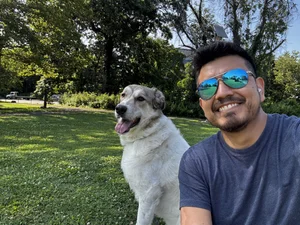
Then somewhere in the early months of 2025, on a drive between Connecticut and Texas with the dog asleep beside me, a quiet question started rising up.
If everything becomes optimized, what do we do with the slow?
What do we do with the wandering. The boredom that softens into thought. The conversation that loops three times before it finds itself. The afternoon you spend on something that goes nowhere. The version of you who only shows up when the day has too much space.
I think about this constantly now.
I have been moving every year for most of my adult life. New apartments, new cities, new ceilings to learn at three in the morning. The boxes packed and unpacked had built a muscle I did not know I had. When 2025 came and the ground shifted under everyone, I realized I had been shifting with it for a decade. The practice had been quietly preparing me the whole time.
So I went toward AI instead of around it. I read. I prompted. I built. I sat in the new tools the way you sit in a new town, learning where the streets bend. And the more I learned, the more certain I became of one thing.
AI is going to remake the world. The economy is the surface. The deeper layer is something else.
The part of us that ties identity to usefulness has spent a long time getting comfortable. What do you do. What do you contribute. What role do you play. Those questions used to come with answers. They are still going to come, but the answers are going to feel different soon, and most of us have not started asking what they mean.
There is one version of this worry I cannot put down.
The companies racing to make the cheapest product are racing by removing the human from the loop. It works, until you remember the human was also the customer. You cannot drain the demand side of a market and expect the supply side to keep dancing. We are trying to out-human the humans, and the math is going to come due. I do not know what waits on the other side. I do not know that anyone does. I just think we should be talking about it out loud, the way you talk about weather coming in from the west.
This part landed in my chest too.
I spent years becoming someone. Degrees. Letters after the name. The slow patient practice of getting good at a thing. And lately I have watched AI take careful bites out of work I thought belonged to people like me.
I expected to feel hollowed out. I felt the opposite.
What it did was loosen the lid on a jar I had been carrying around without noticing. The jar held all the things I had quietly believed I was paid for. The expertise. The hours. The output. And when the lid finally came off, what was actually inside turned out to be something simpler.
It was the room. The light through the window. The student who finally got it and looked up at me with that particular surprise. The walk between buildings on a Tuesday in October. The dog leaning against my leg. The friend who showed up on a Thursday because Thursdays are when we show up for each other. The coffee shop in a town I had no business being in, full of strangers who had also chosen that particular morning.
Presence. That was the actual thing. That had been the actual thing the whole time.
We have been confusing economic usefulness with meaning for a while now. The market got loud, and we started taking our cues from it. Maybe AI is the thing that finally turns the volume down enough for us to hear what we were actually saying to each other.
I have been on the road a lot this year. Connecticut. Texas. New York. Towns whose names I lose by the next exit. Long stretches of highway where the only thing in the car is me, Luna, and a question I have not yet learned how to answer.
Are we traveling to find new places. Or are we traveling to find ourselves in new places.
I keep arriving at both.
What AI has done for me, almost without my permission, is make humanity feel rarer. A thing worth noticing. The more intelligence becomes a service you can call on demand, the more precious the unrepeatable becomes. The friend who knows the story under your silence. The laugh that came from a joke only you would have told. The walk you took because you needed to move, and not because you were going anywhere.
For centuries we have been trying to engineer the friction out of life. The suffering. The uncertainty. The slow patient parts that take longer than we want.
I am starting to think some of that was the point.
The cold morning that wakes the body up. The conversation that goes badly and rearranges you on the drive home. The mistake that becomes the story you tell at dinner ten years later. The skill you cannot do yet, which is also the skill that makes you keep showing up. The not knowing that comes before every kind of knowing worth having.
AI is not going to take any of this from us. AI is going to ask us, in a way nothing else has asked before, whether we still want it.
A hundred years ago, machines made physical labor optional for most of the developed world. We did not stop using our bodies. We invented sports and trails and weight rooms and long quiet runs at dawn. We chose to keep the bodies alive even when survival no longer required it.
I think we are about to face the same choice with our minds. With our hands. With even some kinds of love.
The machine will be able to. The question will be whether we still want to.
I think we do.
As recognition. As remembering. The wandering, the boredom, the slow conversations, the becoming. These are the things AI is showing us were always the heart of it.
The work of the next decade may not be proving we are intelligent enough.
It may be remembering why being human was worth the effort in the first place.
It is late as I write this. The dog is breathing on the passenger seat. The coffee has gone the soft cold of a coffee that has been forgotten. The future is open in the way that uncertain things are always open, and somewhere in the middle of that openness there is a feeling I have started to recognize as hope.
The work ahead is not to become more efficient.
The work ahead is to remember what we were trying to be efficient for.